Awhile back, I was on the phone with my friend, talking about some of the interesting things I’ve been learning on my journey to become a doula. I mentioned that if pregnancy weren’t a thing, and I could have the guarantee of a healthy baby, I’d do the labor and delivery part again, this time ready to complete it without an epidural. Cue Jennifer Lawrence saying “But what do you mean?”
”Why? But why? Why would you do that? Why would anyone NOT want an epidural? Why do women do that to themselves?”
And I get it. In a society that hates pain, why would someone choose to feel the pain when it can so easily be taken away? It’s a valid question. Especially since I DO NOT deal with pain well. I have chronic migraines and, now that I’m getting older, backaches, and I am constantly trying to find remedies that work for me. I don’t embrace discomfort. If my nose tickles I reach for the DayQuil. When I say my brain lives in my body, I don’t mean that I have a brain in my head. I mean that my mind is constantly scanning for the littlest discomfort that I can try to relieve. Shut that shit down.
So why do I so desperately want to do it all again without an epidural?
So, there’s the emotional reasons to opt out of the epidural. The risks are not zero, like with anything else in life. There’s the getting poked with what looks like a huge needle, and discomfort at the end when they have to take it out, And I’m not gonna lie, each time I got an epidural I had a brief panic that the anesthesiologist would do something wrong and I’d end up paralyzed. It’s what I now consider to be an unfounded fear - yes it is possible, but these anesthesiologists know what they are doing and they do epidurals all. Day. Long.
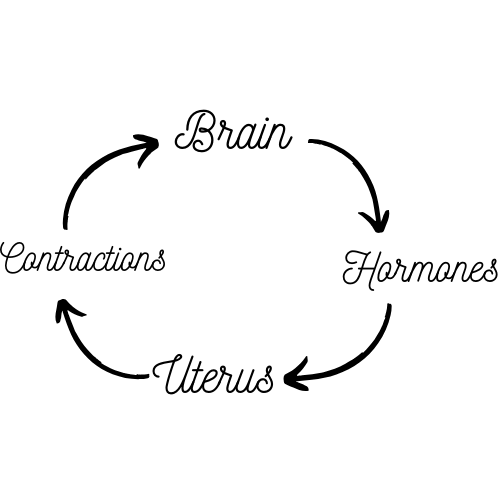
And there are medical reasons to stay away. If you go into labor spontaneously, an epidural can slow everything down, possibly adding Pitocin to your list of interventions. (Pitocin is synthetic Oxytocin, a hormone released by your body. It makes contractions faster and stronger, but does not incur other benefits of it’s natural counterpart.) Basically what happens is that when labor starts, even before you know it, your body is going through a communication cycle. Brain, hormones, uterus, brain, hormones, uterus. (And, of course breasts, lungs, heart, capillaries, and all that, but let’s try to stay focused.) Something happens (we still don’t know what) that pushes the brain/body communication over a tipping point and together they say “THIS BABY IS READY” and labor starts. Slowly. Very very slowly. You can be in labor for a LONG time before you even consider it might be labor. But over hours or days, the labor picks up. Contractions get stronger and closer together. You start wondering if this is it. Hopefully you decide to lay down or take a bath and get as much relaxation in as you can before the marathon of labor and delivery. Eventually the contractions are about five minutes apart, lasting about a minute. You cannot talk through a contraction, you have to focus. Your partner’s jokes are no longer funny. You do not WANT to lay down, I’m fine, leave me alone! Here’s where the partner/support person/birthing person calls the doula, midwife, and/or OBGYN and heads to the agreed upon location to give birth - hospital, birth center, or birthing person’s home.
So right now, the communication cycle looks kind of like this:
Excuse the formatting, I’m still learning how to do this stuff.
Your brain is releasing a nice cocktail of hormones, one of which is Oxytocin. Oxytocin tells your uterus “Hey, we’re doing this NOW”, and contractions continue to get stronger and closer together, as they thin out and open the cervix so baby can make their appearance. It hurts. BAD. And you ask for the epidural.
So the anesthesiologist comes in and hooks you up with the good stuff. You lose feeling from about your belly down. Your legs feel like big slabs of meat that are not connected to the rest of you. It’s weird, y’all. And the pain is gone.
But wait? What happened to that communication cycle? Surely nothing has changed?
Not exactly. Or at least, not always.
Let’s be clear: none of this is 100% true 100% of the time. If your body was ready for labor, the contractions might not change. But if your body was on the fence about going into labor, they could.
Pain from contractions normally triggers your brain to release more oxytocin. Because the epidural blocks that pain, your body may slow the flow.
And now the communication cycle looks more like this:
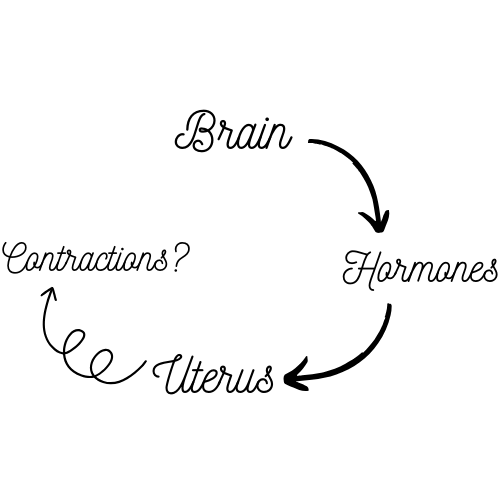
Are you still having contractions? I mean, yeah. But they may change. They may slow down and become weaker. They could stop altogether. Or they could continue along the path they were on before, increasing in intensity and speed.
What if they slow down? Enter Pitocin. Remember her? It’s that synthetic version of Oxytocin we talked about. She does the work. She makes contractions stronger again. But she’s not your brain, and she’s not getting feedback from your uterus. If contractions become too strong or baby doesn’t like them, Pitocin don’t care. She just keeps dripping at whatever rate she’s set at, not able to pay attention at all to how it’s affecting you or your baby.
Which, in most cases, isn’t a problem. Doctors are paying attention to your body and your baby, and they can increase or decrease the pit drip. You can go on having strong, fast contractions and you don’t feel any pain. And they will be paying close attention to baby, because baby feels it. Most of the time it’s not a big deal. Birth is stressful, with or without interventions. Babies get stressed. But sometimes the Pitocin is too much. Baby gets REALLY stressed. In extreme (and rare) cases, doctor might call for a c-section. One that might not have been necessary without all of the interventions.
Don’t let me fear monger you. Not every epidural ends in c-section. I had four epidurals and no c-sections. Anecdotes are the worst kind of “evidence”, I know, but I’m just saying. An epidural does not automatically mean you will get a c-section. I just wanted to connect those two dots so you can see how they are related.
All of this so far is the story of you starting labor spontaneously. Sometimes we get induced. Might be for a medical reason, might not. I am not here to judge anyone’s decisions - even with everything I knew I still got induced all four times, and only two of those were medically necessary. The truth is, pregnancy can be HARD. I’ve always wanted babies. I’ve always loved my babies before they were even conceived. But my body is NOT great at being pregnant. Painful contractions started for me about halfway through my first pregnancy. My second pregnancy ended in miscarriage. My next two pregnancies were okay, but for the excessive vomiting. My last pregnancy was induced because of preeclampsia. My point is, I’m not here to tell you that elective induction is right or wrong. It will all depend on you and your situation.
That being said, induction without epidural SUCKS. The contractions are SO BAD. And they increase in severity so quickly that your body’s beta-endorphins might not be able to handle the pain. (You didn’t know there are hormones that reduce pain, did you?) All of which explains why induced labor has a positive correlation with epidural use. Is it possible to be induced and go through the whole thing without the epidural? Of course. It happens all the time. And there are steps you can take to help you succeed at it. But statistics do show that induction is more likely to include an epidural than not. And those numbers might be skewed because if you are planning to get induced, it’s likely you are already planning to get the epidural. I’d love to read a paper that talks about planned induction without planned epidural, and how often the birthing person ends up getting the epidural. If anyone knows of such a paper, please email it to me!
So that’s the short version of medical reasons one might want to decline the epidural (and there are actually more, but this is already very long for a blog). But there are other reasons, too. Personal reasons.
Some people just want to be as present as possible for the birth of their baby. They don’t want to be numb. They want to feel everything. And that is valid.
Some people want to prove to themselves that they can do it. It’s a test that they insist on passing. And that is valid.
Some people have a distrust of doctors or hospitals. Maybe they have a history of medical trauma. Maybe someone they know went through something. But for whatever reason, they want as few needles and interventions as possible. And that is valid.
Some people feel an intimate connection with nature and/or their bodies, and they want to trust what their body can do. A healthy pregnancy with a healthy birthing person and a healthy baby should not require intervention. Some people want to retain feeling in their bodies so that they can keep that communication open. They trust what their body is doing and will listen to it and respond to it. I’ve witnessed this before, and it’s quite beautiful. And it’s valid.
That being said, some people ask for the epidural right away, and that is also valid.
So. This is much longer than I had anticipated. Stream of consciousness writing does that to me. Am I trying to say epidurals are always bad? Heck no. Are there reasons you SHOULD get an epidural? Of course. I was going to include those in this blog entry, but I think it might have to wait until tomorrow. My point here is not to demonize epidurals, but to answer the question “Why do some people want to decline the epidural?”. Every intervention used today has an appropriate circumstance for use. You probably have a hammer in your home, right? You wouldn’t use it to put a sticker on the fridge, would you? That doesn’t make the hammer bad, it just means that it has it’s applications. Epidurals are just another tool in the toolbox when it comes to labor and delivery. There is no “always” or “never”, just what’s appropriate in the circumstances.